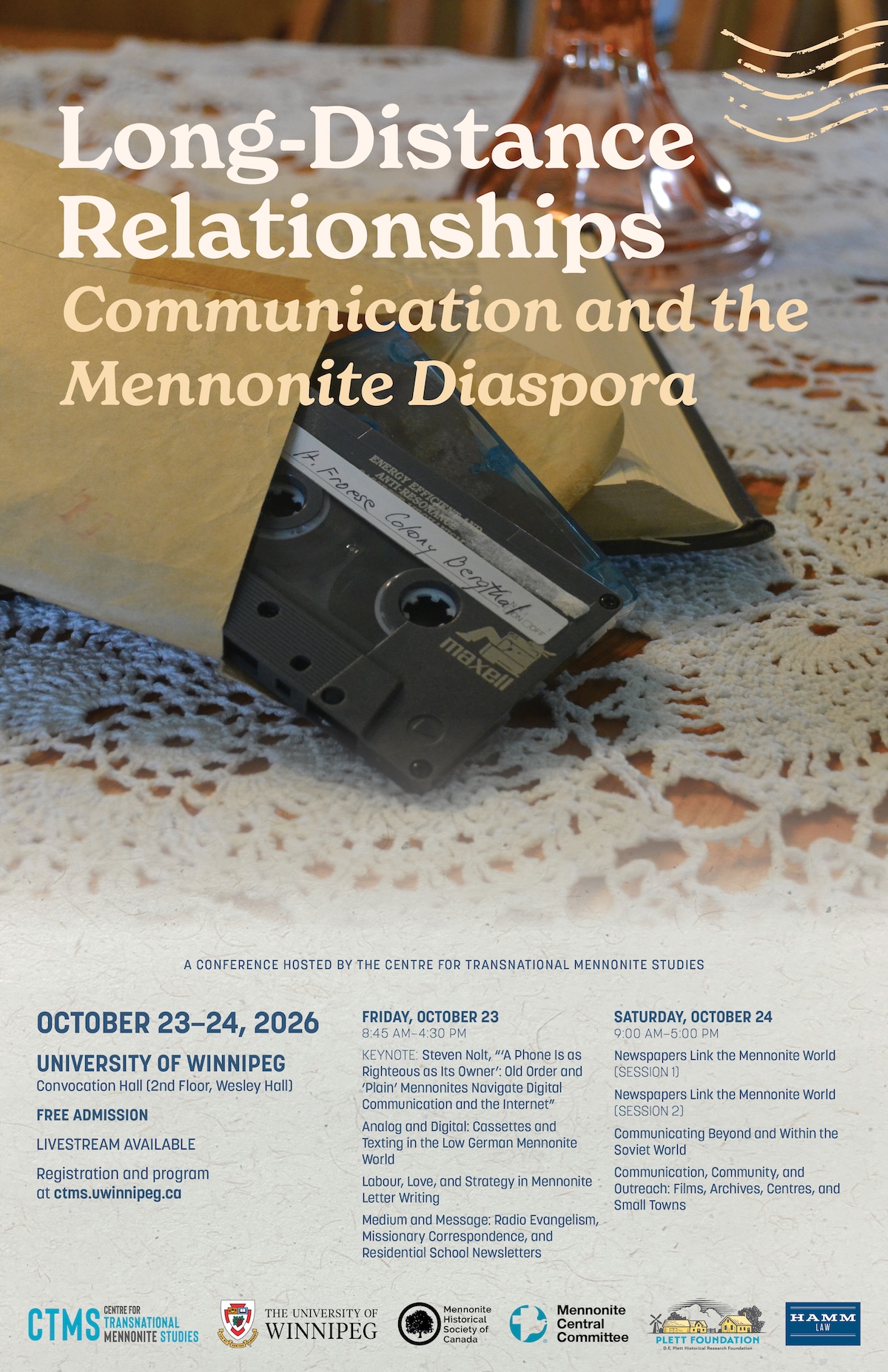

This conference will consider how Mennonites and other Anabaptists have met the persistent challenge of communication within an increasingly dispersed global community. Even as communication over great distances was often difficult, the imperative to speak across borders became particularly pronounced when it was connected to prospects for new settlement ventures, the extension of mutual aid during war and revolution, or the affective bonds of family. This pattern dates to the earliest periods of Anabaptist history, when letters helped sustain relations between believers during times of persecution, and continued over the centuries as migrations separated Mennonites by ever greater distances. Advances in print technology in the nineteenth century facilitated the growth of Mennonite newspapers, whose articles and published correspondence fostered a sense of a “transnational village.”
At times, communication implied reckoning with linguistic, cultural, and technological barriers. This was evident in language shifts in acculturating communities as well as missionary work and the growth of Indigenous churches throughout the Global South. For some traditionalist Anabaptist communities, use of certain communication devices also became a point of contention. From letter-writing to the printing of pamphlets and newspapers to the use of radio, TV, social media, and WhatsApp, conference presentations will foreground historical questions related to the various dimensions of communication.
Jump down to the conference schedule
Conference Livestream
If you would like to ask a question during the discussion period, enter it in the live chat on the video’s YouTube page. Or, send us an email.
Schedule
In-Person and Livestreamed
Friday, October 23
8:45–9:00 a.m.
Welcome and Introduction
- Welcome: Jino Distasio, University of Winnipeg Interim President
- Conference Introduction: Ben Nobbs-Thiessen, Chair in Mennonite Studies
9:00–10:00 a.m.
Keynote Address
- Steven Nolt, “‘A Phone Is as Righteous as Its Owner’: Old Order and ‘Plain’ Mennonites Navigate Digital Communication and the Internet”
10:00–10:30 a.m.
Coffee Break
10:30 a.m.–12:00 p.m.
Analog and Digital: Cassettes and Texting in the Low German Mennonite World
- Chair: Ben Nobbs-Thiessen
- Patricia Harms, “‘I have two hearts’: Forty Years of Transnational Conversations”
- Tina Fehr Kehler, “The Cassette Tape: The Dietsche Mennonites’ First WhatsApp”
- Margarita Penner, “From Radio Waves to WhatsApp: Connecting Mennonite Communities Across Borders”
12:00–1:00 p.m.
Lunch Break
1:00–2:30 p.m.
Labour, Love, and Strategy in Mennonite Letter-Writing
- Chair: Jeremy Wiebe
- Isaac Weber, “Imagining a Global Church from Upper Canada: Benjamin Eby and the Waterloo Mennonites, 1805–1853”
- Arnold Neufeldt-Fast, “‘Please Do Not Forget Us’: Women’s Epistolary Labour, Maternal Thinking, and Transnational Survival in Fürstenland, 1921–1933”
- Dora Dueck, “Epistolary Courtship: The Letters of Heinrich Harder and Helena Derksen”
- Christina Barwich and Valentina Berger, “Letters Across the Iron Curtain: Fifty Years of Correspondence Between Two Mennonite Sisters”
2:30–3:00 p.m.
Coffee Break
3:00–4:30 p.m.
Medium and Message: Radio Evangelism, Missionary Correspondence, and Residential School Newsletters
- Chair: Royden Loewen
- Aileen Friesen, “Crossing the Atlantic: A Physical and Figurative Reunion in the Rundschau”
- Michaela Hiebert, “‘Our Speaking Could Carry Weight’: Canadian Mennonites and Radio Evangelism to the Soviet Union”
- Myrrl Byler, “Communication Challenges for Mennonites Living in China: 1900 to the Present”
- Jasmine Wiens, “Hiding Behind the Bible: Biblical References as Communication Tool in the Newsletters from Poplar Hill Residential School”
Saturday, October 24
9:00–10:30 a.m.
Newspapers Link the Mennonite World, Session 1
- Chair: Adam Nikkel
- Rosemary Vogt, “The Transnational Village: Mennonite Communication and the Early Formation of Networked Belonging”
- Caroline Dueck de Klassen, “From the Chaco to the World: Mennoblatt and the Careful Representation of a New Mennonite Colony”
- Kennert Giesbrecht, “Die Mennonitische Post: Fifty Years of Letters and News”
- Yann le Polain, “The Shape of a Diaspora: Using the Mennonitische Post to Map Transnational Networks among Latin America Mennonites”
10:30–11:00 a.m.
Coffee Break
11:00 a.m.–12:30 p.m.
Newspapers Link the Mennonite World, Session 2
- Chair: Janis Thiessen
- Chris Sundby, “Communicating Crisis: Mennonites, Leo Tolstoy, and a Forgotten Famine”
- Sherry Sawatzky-Dyck, “Early Der Bote on Patriarchy and Women’s Suffering as a World View”
- Laureen Harder Gissing, “The Talk: Canadian Mennonites Communicate About Sex, Sexuality, and Gender, 1970–2020”
- Jonathan Hildebrand, “Family Gatherings, Wedding Showers, and … Anxious Crows? Finding Environmental History in Newspaper Social Columns”
12:30–1:30 p.m.
Lunch Break
1:30–3:00 p.m.
Communicating Beyond and Within the Soviet World
- Chair: Nataliya Venger
- Werner Toews, “Letters from Jacob”
- Waldemar Masson, “Letters from America: Transnational Family Communication between the Soviet Union and the West in the Twentieth Century”
- Andrei Fast, “A Century of Separation, Silence, and Reunion: The Story of the Fast Family between Canada and the Soviet Union”
- Natalia Khanenko-Friesen, “Epistolary Resistance in Trans-Border Family Letter Writing: Navigating KGB Interference in Times of Cold War”
3:00–3:30 p.m.
Coffee Break
3:30–5:00 p.m.
Communication, Community, and Outreach: Films, Archives, Centres, and Small Towns
- Chair: Steve Dueck
- Nataliya Venger, “Tradition and Communication as Resources: The Activities of the Mennonite Centre in Molochansk”
- Amir Lavie, “Canadian Jewish Archives as Sites of Intergenerational Diasporic Communication”
- Brian Froese, “And When They Shall Watch: Canadian Mennonites and the Screen Arts, 1970–2020”
- Howie Kehler, “Fear of the Unknown: Communication, Policing, and the Arrival of Dietsche Migrants in Southern Alberta”
5:00 p.m.
Conference Wrap-Up
Major Contributors: Special thanks to the Mennonite Historical Society of Canada, Mennonite Central Committee, the D. F. Plett Historical Research Foundation, and the University of Winnipeg.